The office dress code has fractured. The same job title means a wool suit in one company and dark jeans in another. The same wardrobe that works for a Monday client meeting now has to also work for a Friday standup. Most men dress for one of these worlds and fumble the other — the traditional dresser in a suit at a tech startup looks oddly stiff; the smart-casual dresser in a polo at a law firm looks unprepared. This guide is twelve outfits, mapped across every modern office context, built around a small wardrobe that flexes between them.
The line this guide holds: the office wardrobe is small and flexible. A man with a navy suit, a tweed sport coat, two pairs of wool trousers, two pairs of cotton chinos, one pair of dark jeans, three shirts, two knits, and three pairs of shoes covers every dress code from boardroom to creative-startup. The error is owning multiple weak versions of each piece. One good navy suit beats three mediocre ones; one perfect oxford-cloth shirt beats five fast-fashion shirts that pill in a year.
1. The navy suit — traditional business
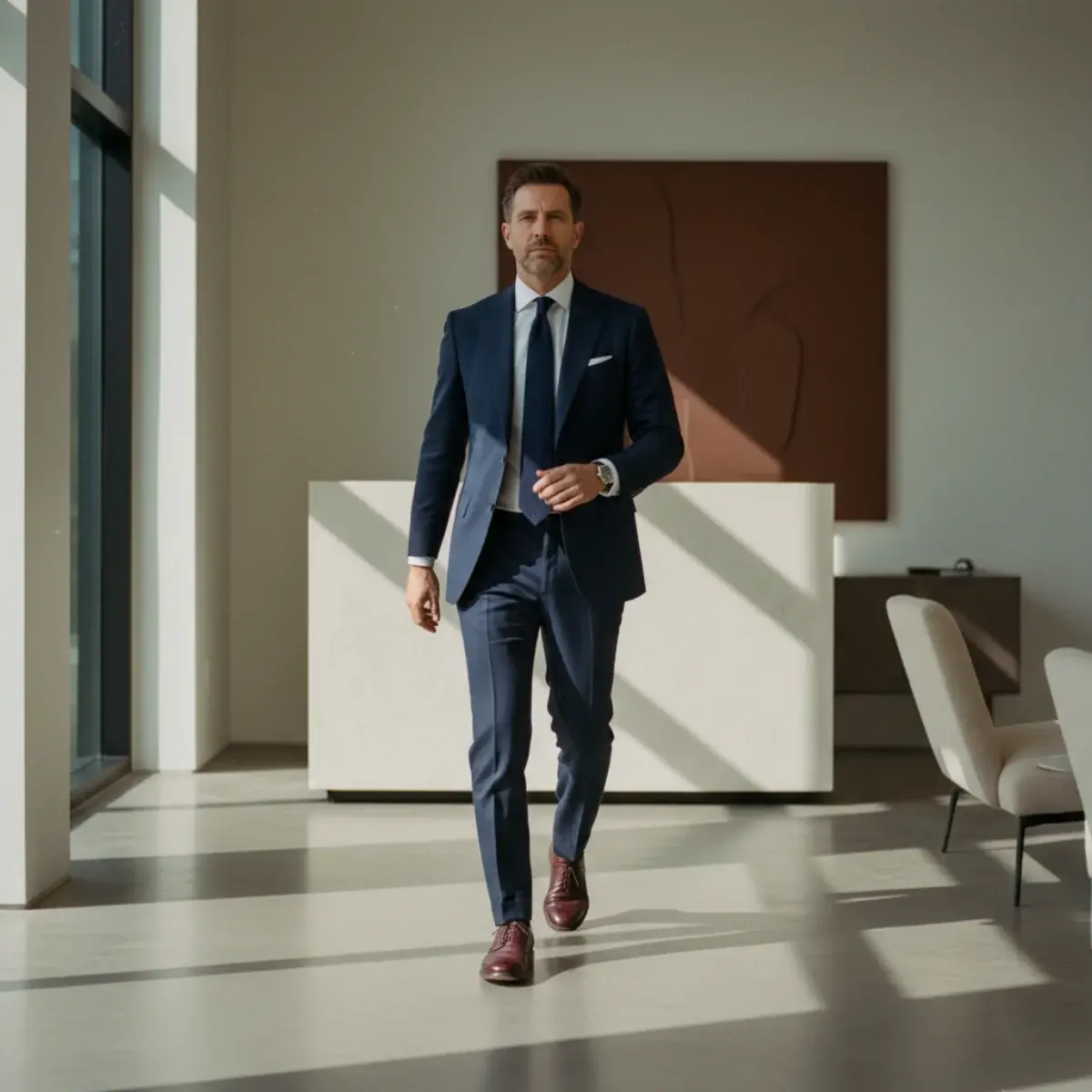
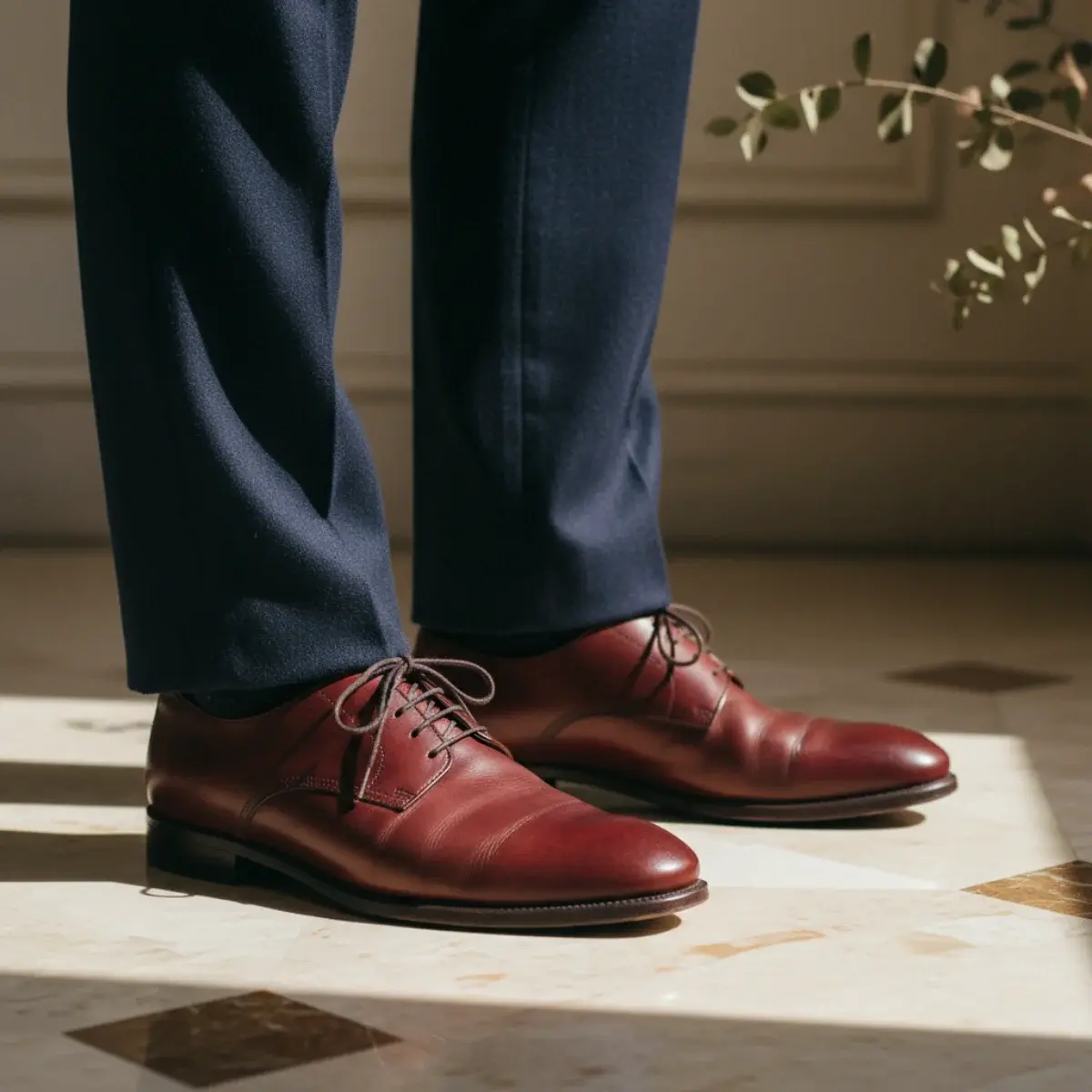
The cleanest formal office outfit a man can wear. A two-piece wool suit in mid-navy (not too dark, not too bright), worn with a white poplin shirt, a navy grenadine or knit silk tie, a white pocket square folded in a TV-fold, a black or oxblood leather oxford, and a leather belt matching the shoes. A simple watch on a leather strap. This is the outfit that handles every traditional-office context — interviews, client meetings, formal events.
 1600×1067
Fit notes. The shoulder seam sits at the shoulder, not droops past it. The jacket length covers the seat. The trouser breaks once on the shoe (a single soft fold) — anything more bunches. The shirt cuff shows half an inch past the jacket sleeve.
2. The charcoal suit — formal alternative
The other traditional-business workhorse. A charcoal worsted wool suit in a fine herringbone or solid weave, paired with a pale-blue poplin shirt, a deeper-toned tie (forest, oxblood, or charcoal-patterned silk), black derby shoes, and a black leather belt. Charcoal reads slightly more formal than navy in some industries (finance, law); pick based on what your peers wear.
 1600×1067
3. The tweed sport coat — smart office, cooler weather
The mid-formality fall and winter office outfit. A tweed or wool sport coat in herringbone, glen check, or a textured solid, worn over a fine-gauge merino crewneck (no shirt, no tie) or over an oxford-cloth shirt with no tie, paired with mid-grey wool trousers, and brown leather derby shoes or oxblood loafers. The sport coat handles smart business casual through creative-industry-business; the inner layer sets the formality.
 1600×1067
4. The oxford and chinos — business casual
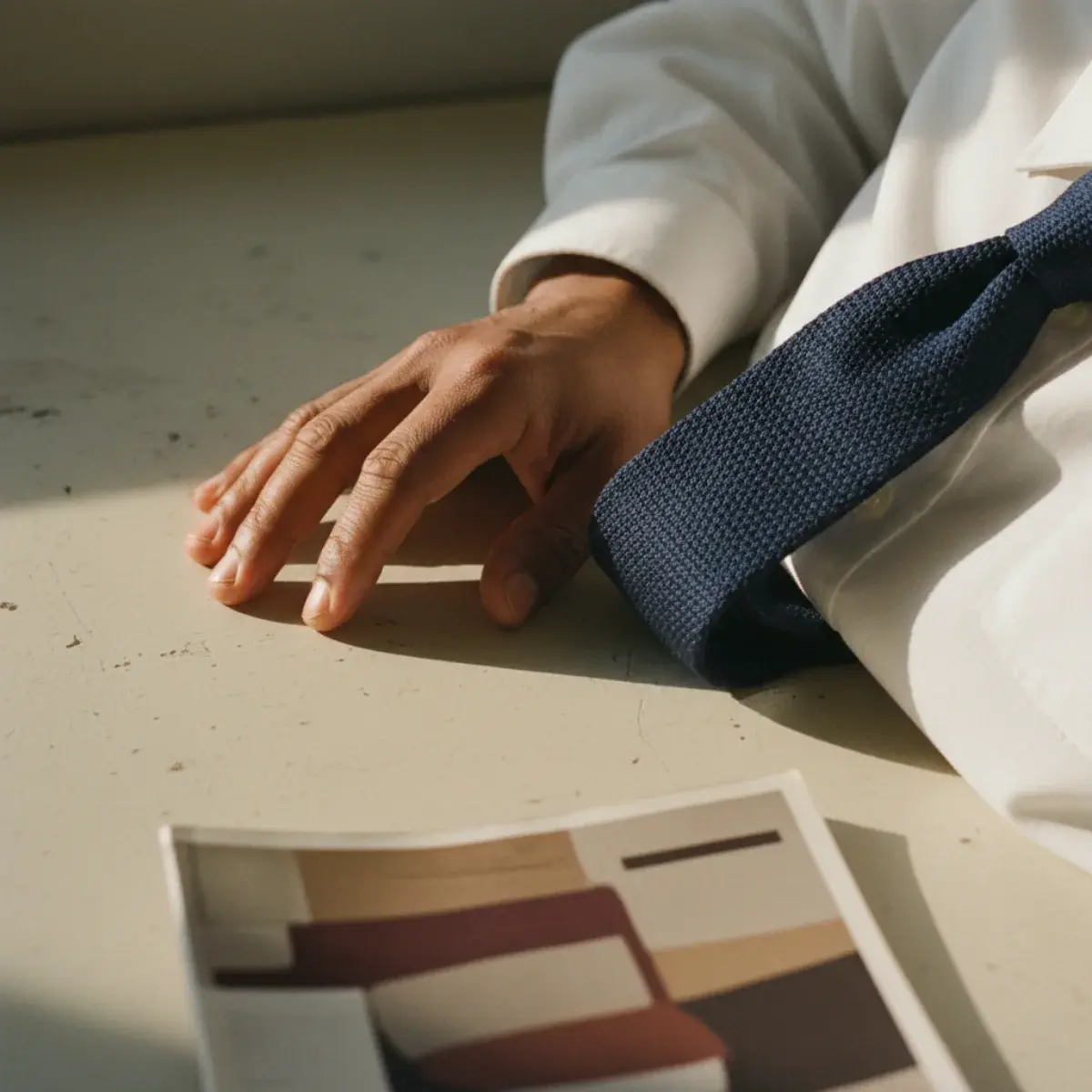
The business-casual workhorse. A pale-blue oxford-cloth button-down tucked into stone or tobacco cotton chinos, with a brown leather belt and brown leather penny loafers. A leather watch. This is the outfit that works for nine in ten business-casual offices on any given day.
 1600×1067
Fit notes. Chinos break once on the shoe; the shirt is tucked with a clean line at the front; the cuff hits the wristbone with no bagging. The belt's leather matches the loafer's leather.
5. The fine-knit and trouser — smart casual
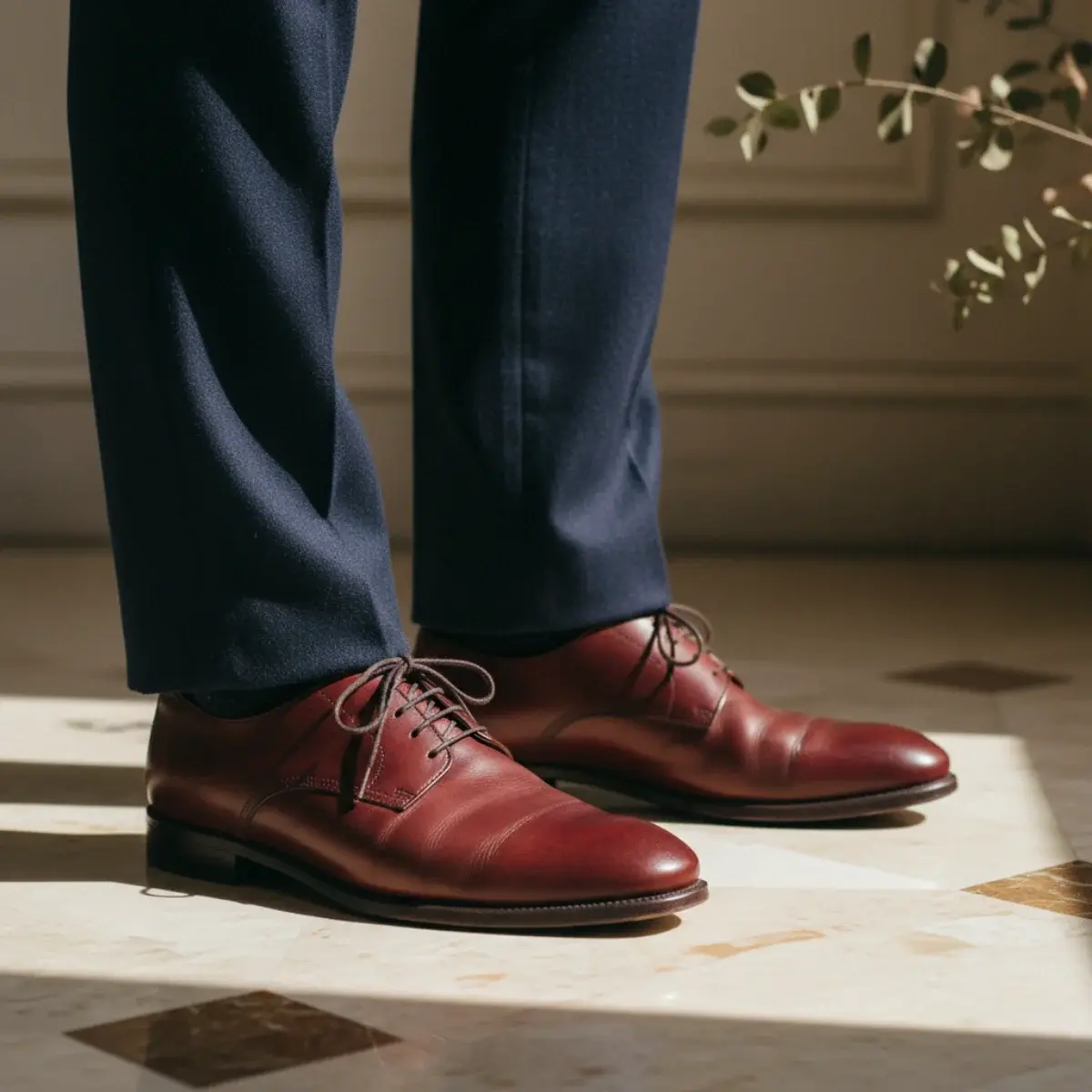
The dressier-casual office outfit. A fine-gauge merino crewneck in navy, oatmeal, or charcoal, worn over a fitted white t-shirt (collar visible at the neck) or over an oxford shirt (collar out), paired with mid-grey wool trousers and brown leather penny loafers. No belt visible if the knit covers it; a leather belt that matches the shoes if it shows.
 1600×1067
6. The polo and chino — smart casual, warmer weather
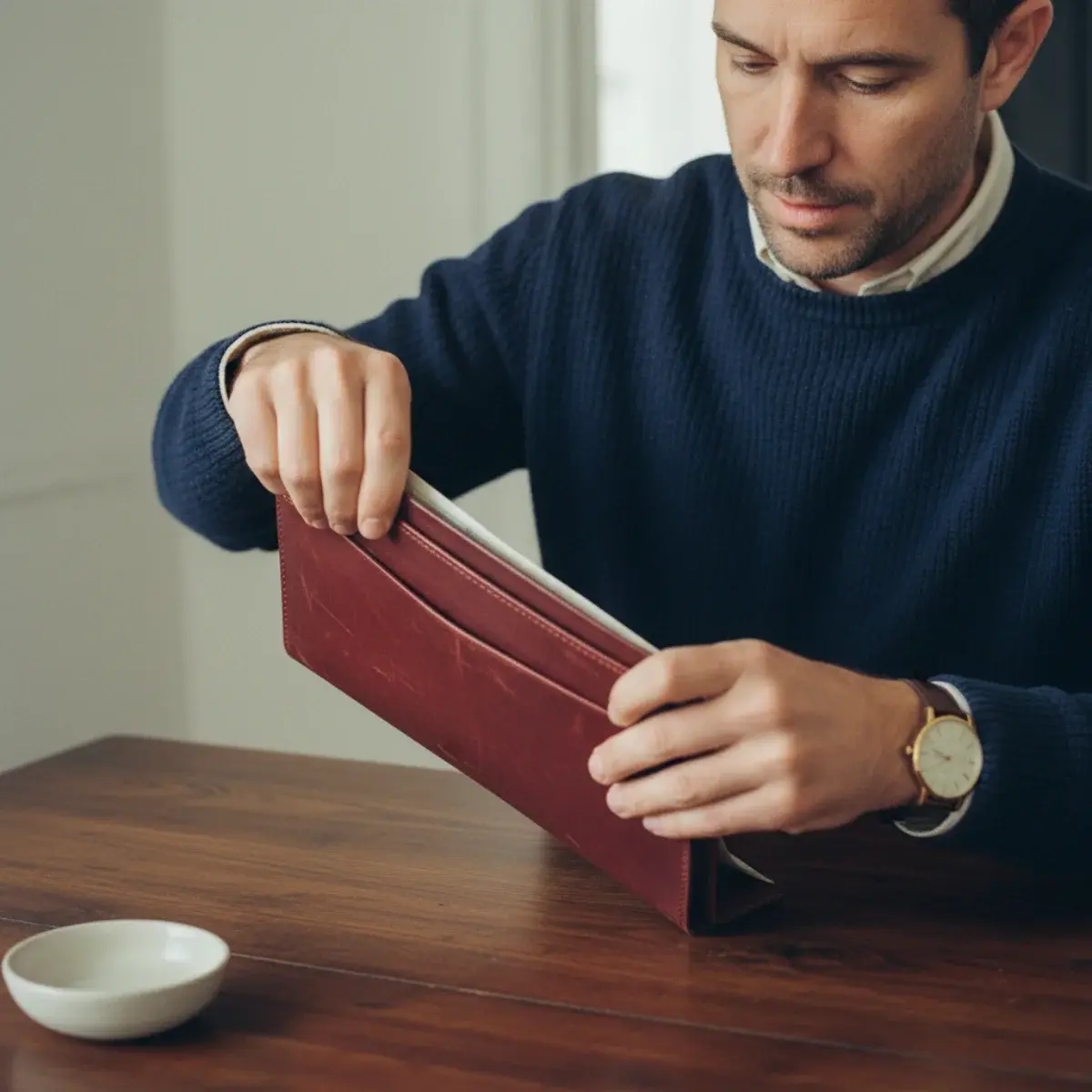
A fine-gauge cotton or merino polo in a deeper colour (navy, forest, oxblood, charcoal), tucked into stone or tobacco chinos with a brown leather belt and brown leather loafers. The collar lies flat (never popped). For summer offices that don't require a button-down; works for casual Fridays in business-casual environments.
 1600×1067
The office wardrobe is the most over-bought category in men's clothing. Most men own too many shirts and too few good ones.
7. The dark jeans and oxford — smart casual / creative casual
Where dress codes allow denim. Dark indigo straight-leg or slim-straight jeans (hemmed cleanly, no break), an oxford-cloth shirt with the sleeves rolled twice at the forearm, a brown leather belt, and brown leather penny loafers or clean white leather sneakers. The jean must be dark indigo or near-black; mid-blue jeans read weekend, light-wash jeans never read office regardless of code.
 1600×1067
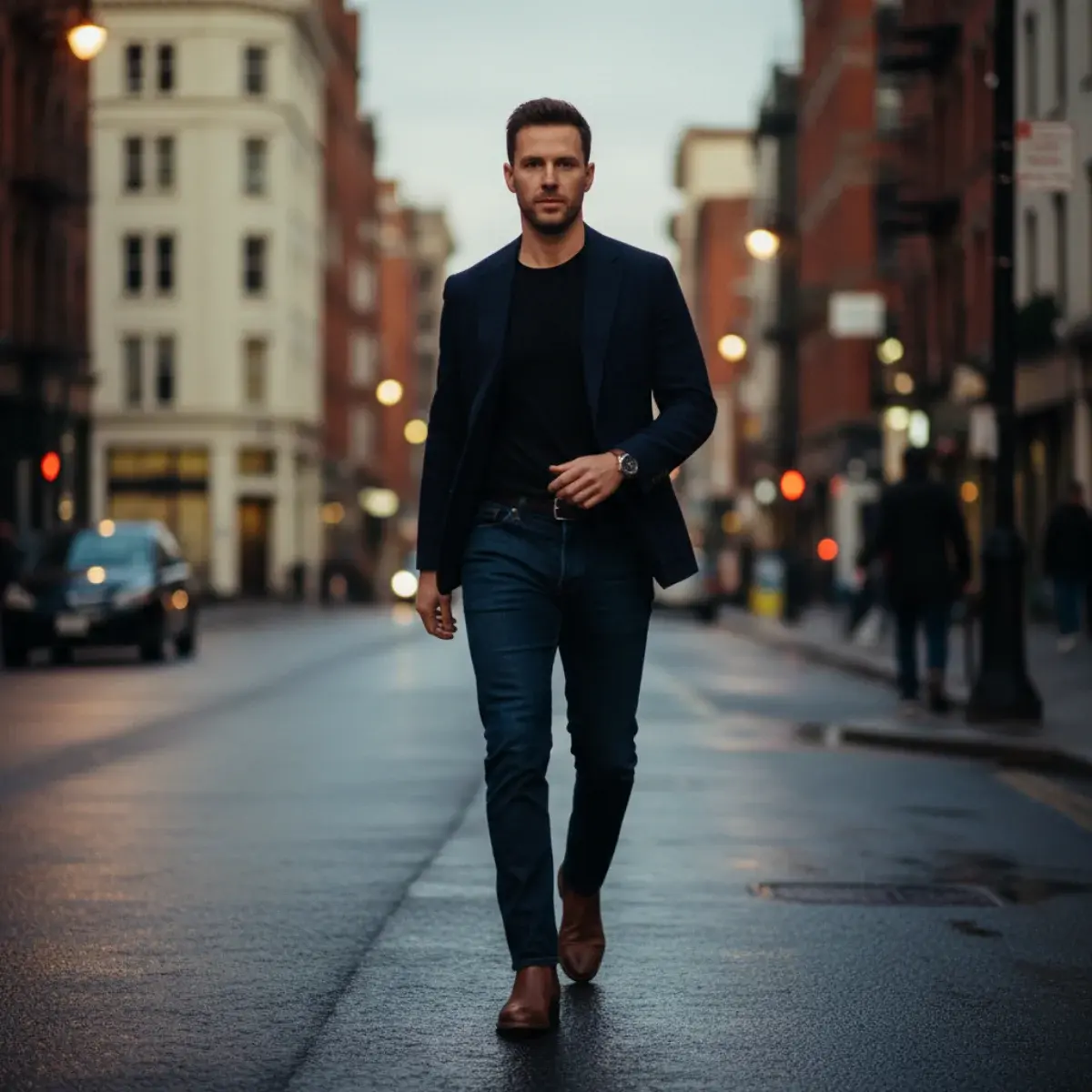
8. The unstructured blazer and t-shirt — creative-industry
The modern creative-office outfit. A navy unstructured blazer (no shoulder pad, no lining, more like a heavy shirt than a suit jacket) over a heavyweight fitted white t-shirt, with dark indigo straight-leg jeans or charcoal wool trousers, and clean white minimalist leather sneakers or brown loafers. A leather-strap watch.
Where this works. Creative agencies, tech companies, design studios, modern media offices. Where it fails: law firms, traditional finance, government, any client-facing role where the client expects a tie. Read the room.
 1600×1067
9. The chore coat over a knit — creative casual
The most-casual office outfit on this list. A tobacco or charcoal cotton chore coat worn over a fine-gauge merino crewneck (with a fitted t-shirt's collar visible at the neck), with dark indigo straight-leg jeans and brown suede chukka boots. Works for genuinely casual creative offices; reads weekend in any business-casual setting.
 1600×1067
10. The all-grey office outfit
A subtle but considered combination. A charcoal wool sport coat, a mid-grey fine-gauge merino crewneck, mid-grey wool trousers (a shade lighter than the coat), and oxblood or burgundy derby shoes (the only warm tone). The monochrome reads intentional; the warm-tone shoes prevent the look from going severe. Works for business casual through smart casual.
 1600×1067
11. The summer office outfit
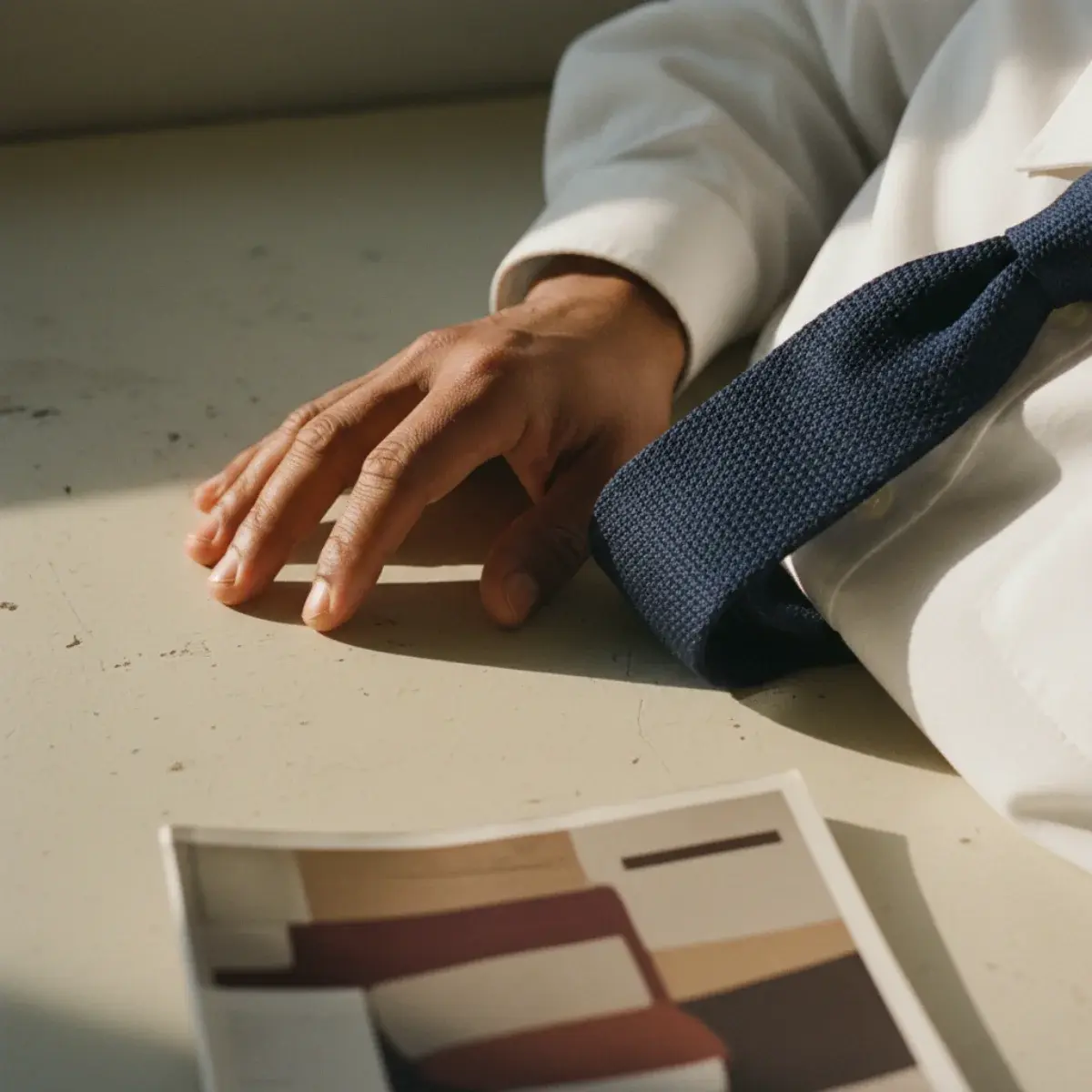
The hot-weather office uniform. A pale-blue or white oxford-cloth shirt with the sleeves rolled twice, lightweight cotton or cotton-linen trousers in stone or tobacco, and brown leather penny loafers worn sockless (with no-show socks). A leather belt and watch. Skip the jacket once temperatures clear 25°C — the rolled-sleeve oxford with proper trousers reads more considered than a sweated-through sport coat. See the men's summer outfits guide for the broader warm-weather playbook.
 1600×1067
12. The winter office outfit
The cold-weather office uniform. A wool overcoat (navy, charcoal, or camel) over the day's office outfit (suit, sport coat, or business-casual layering), with a knit wool scarf at the neck, leather gloves, and brown leather Chelsea boots or leather derby boots. The overcoat finishes the look outside; comes off cleanly to reveal the inside layers in the office. See the men's winter outfits guide for the full cold-weather wardrobe.
 1600×1067
Key takeaways
- 1Four dress codes cover almost every modern office: traditional business, business casual, smart casual, creative-industry casual.
- 2A navy suit, a tweed sport coat, two pairs of wool trousers, two pairs of chinos, one pair of dark jeans, three shirts, two knits, and three shoes cover every code.
- 3One good suit beats three mediocre ones. Spend up if the role demands a suit; skip altogether if it doesn't.
- 4The brown leather penny loafer or derby is the most-useful office shoe — handles business casual through smart casual cleanly.
- 5Dark indigo straight-leg jeans work in smart-casual and creative-industry offices. Mid-wash jeans never read office.
- 6Fit decides everything. Shoulder seam at the shoulder, trouser breaking once at the shoe, shirt cuff at the wristbone.
Reading the dress code
Most modern offices don't write the dress code down. The actual code is communicated through three signals:
What the most-senior person wears. Whatever the executives, partners, or founders wear sets the upper bound. You can dress slightly less formally than they do; you can't dress more formally without reading like you misunderstood.
What the most-formal client meeting requires. The day a major client visits is the day everyone dresses up by one notch. Whatever that one-notch-up looks like is the ceiling of your range.
What your peers wear consistently. What three people at your level wear most days is what the actual daily code is. Match it. Outliers (the man overdressed every day, the man perpetually under-dressed) read as social signals — calculate which one you want to be.
The mistake is assuming the dress code is a single point. It's a range, and reading the range is most of the work of office dressing. A traditional law firm's range might be navy-suit-with-tie to charcoal-suit-without-tie; a tech startup's range might be t-shirt-and-jeans to unstructured-blazer-and-dark-jean. Knowing which end of your office's range you're operating in matters more than any individual piece.
The office wardrobe, in order
If building from scratch for any modern office, buy in this sequence:
- One navy wool suit — single-breasted, two-button, plain front trouser
- Two pairs of wool trousers — one mid-grey, one charcoal
- Two pairs of cotton chinos — one stone, one tobacco
- One pair of dark indigo straight-leg jeans — clean hem, no distressing
- Three oxford-cloth button-down shirts — two pale blue, one white
- One white poplin shirt — for the suit and dressier shirts-with-tie
- Two fine-gauge merino crewnecks — oatmeal and navy
- One unstructured navy blazer — for the creative-industry office days
- One pair of brown leather penny loafers — daily smart-casual workhorse
- One pair of brown leather Chelsea boots — cold-weather alternative
- One pair of black or oxblood derby shoes — for the suit and dressier outfits
- One leather belt in brown, one in black — matched to the shoe leather
Twelve pieces. The complete office wardrobe of a man who can dress for any modern office context, has nothing redundant, and can replace each piece as it wears out without the wardrobe ever drifting. Add a tweed sport coat once the basics are in rotation; add a charcoal suit if the role demands two suits.
Where office outfits fail most often
Three common mistakes:
Buying multiple cheap suits instead of one good one. A cheap suit reads cheap from across the room — the fabric has visible shine, the shoulders are fused (not canvased) and read stiff, the lining shows where it shouldn't. A man with one $800 suit out-dresses a man with three $200 suits at every event. Save until you can buy the right one.
Mismatching the shoe leather and belt leather. Brown belt with black shoes is the most common office accessory mistake. The leathers must match — and if you're wearing a brown belt, every other piece of leather on your outfit (watch strap, wallet) should be roughly the same brown.
Wearing the wrong fit. The 2010s slim fit reads dated in 2026 — modern fit is close to the body but not tight. The shoulder seam at the shoulder. The trouser leg straight or slim-straight (never skinny, never wide). The jacket length covering the seat. The shirt fitted through the body without straining at the buttons. The trouser breaking once at the shoe.
The general principle: every dress code rewards specificity. A man who has read his office and bought one perfect outfit for it out-dresses a man with twelve okay outfits. Build the small wardrobe; rotate it deliberately; replace pieces as they wear out, not before.
Comparison: office dress codes side-by-side
| Element | Traditional | Business Casual | Smart Casual | Creative Casual |
|---|---|---|---|---|
| Jacket | Wool suit jacket | Sport coat or none | Unstructured blazer or none | Optional — blazer or chore coat |
| Shirt | Poplin with tie | Oxford with/without tie | Oxford rolled-sleeve, polo, fine knit | T-shirt, knit, casual button-up |
| Trouser | Wool suit trouser | Wool trouser or chino | Chino or dark jean | Dark jean, chino, casual cotton |
| Shoe | Oxford or derby | Derby or penny loafer | Loafer or clean white leather sneaker | Leather sneaker or low boot |
| Accessories | Tie always, pocket square optional | Tie occasional | No tie | No tie |
| Belt | Match shoe leather | Match shoe leather | Match shoe leather | Optional |
The pieces shift one notch left as the code gets more casual. The principle holds: every piece must still be specifically chosen, just in a different register. A clean white t-shirt under an unstructured blazer is as deliberately-selected as a poplin shirt under a suit jacket; neither is "casual" in the sense of careless.
See all men's outfit guides → · Men's casual outfits → · Men's footwear guide → · Business casual with jeans →
Frequently asked
- What should a man wear to a modern office?
- Depends on the dress code. Traditional business: a wool suit (navy or charcoal), white or pale-blue shirt, conservative tie, black or oxblood derby or oxford. Business casual: chinos or wool trousers, an oxford shirt or fine knit, a leather loafer or derby. Smart casual: dark jeans or chinos with a fine-knit or polo, leather loafers or clean white sneakers. Creative-industry casual: dark jeans, a clean t-shirt or knit, an unstructured blazer or chore coat, leather sneakers. The pieces overlap; only one or two change between codes.
- Do I still need a suit in 2026?
- Depends on what you do and where you do it. If you work in law, finance, consulting, government, or any traditional client-facing industry, yes — own one or two. If you work in tech, design, creative industries, or any modern office, one suit on standby for the rare formal event covers it (a wedding, a funeral, a court appearance). Buying multiple suits for an office that doesn't require them is a wardrobe sunk cost. Own one good suit; spend the rest of the budget on what you wear every day.
- What's the most useful office shoe?
- A brown leather penny loafer or a brown leather derby. The loafer handles smart casual through business casual; the derby handles business casual through traditional business. Both pair with chinos, wool trousers, and dark jeans where the dress code allows. A black oxford is the most-formal office shoe but the most-limited — buy only when the dress code genuinely needs it. The [men's footwear guide](/mens-footwear-guide) covers the full shoe wardrobe.
- Can I wear jeans to the office?
- Depends entirely on the dress code. In traditional business or business casual: no, dark wool or cotton trousers only. In smart casual or creative-industry casual: yes — but only dark indigo straight-leg or slim-straight jeans, hemmed cleanly, with no distressing or whiskering. Light-wash or distressed jeans never read office-appropriate regardless of how relaxed the code. See the [business casual with jeans guide](/business-casual-outfits-with-jeans) for the where-it-works details.
- What's the right shirt for office wear?
- The oxford-cloth button-down is the office workhorse — white or pale blue, in a regular fit (not slim, not loose), with the sleeves the right length (cuff hits the wristbone). For dressier days, a poplin shirt (smoother weave, slightly more formal). For casual offices, the same oxford with the sleeves rolled twice. Skip: short-sleeve dress shirts (look immature in offices), patterned shirts in busy prints (the pattern dates fast), shirts with contrasting collars or cuffs (read banker-trader and not in a good way).
- Should I tuck my shirt at the office?
- In traditional business or business casual, always — and with a leather belt that matches the shoe leather. In smart casual, depends on the shirt cut — a hem long enough to cover the belt should be tucked; a shorter modern hem can be left untucked if the cut is shaped for it. Half-tucks (front-only tucks) read undergraduate; commit to one or the other. With knits, tucking is always optional — a fine-gauge crewneck never tucks; a heavier knit never tucks; only the shirt question matters.
- What's the biggest mistake men make dressing for the office?
- Three common errors. Buying a cheap suit (visible cheap fabric, fused construction, ill-fitting shoulders — none of which can be fixed by tailoring) instead of one good one. Wearing shoes that don't match the rest of the outfit's formality (sneakers under a wool suit, dress oxfords with cargo pants). And ignoring fit — the modern fit for office wear is closer to the body than dad's office, but not skintight. The shoulder seam at the shoulder, the trouser breaking once at the shoe, the shirt sleeve at the wristbone. Get fit right and even mid-priced pieces look considered.
Written by Theo Ashworth, looksyra editorial. Last updated May 2026.