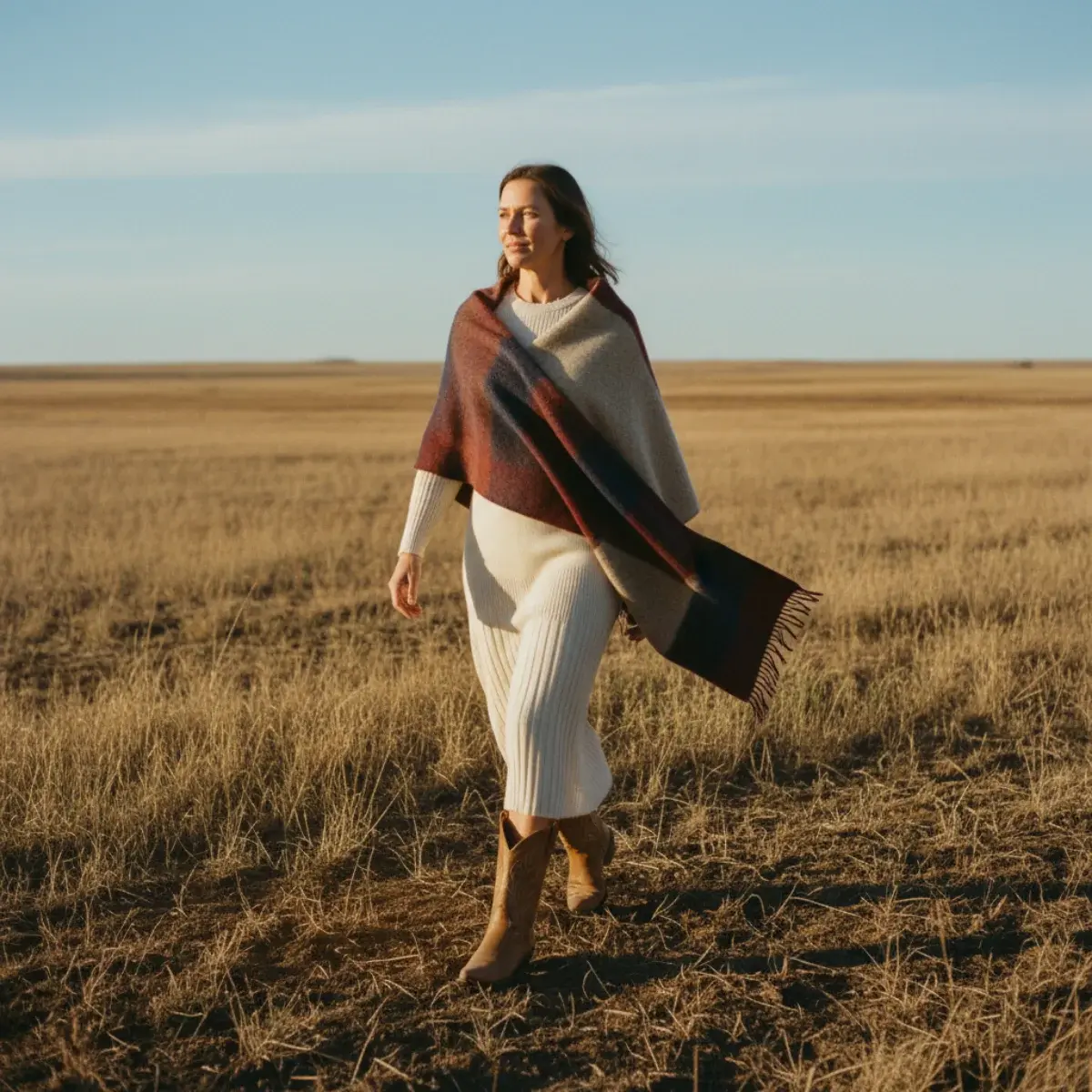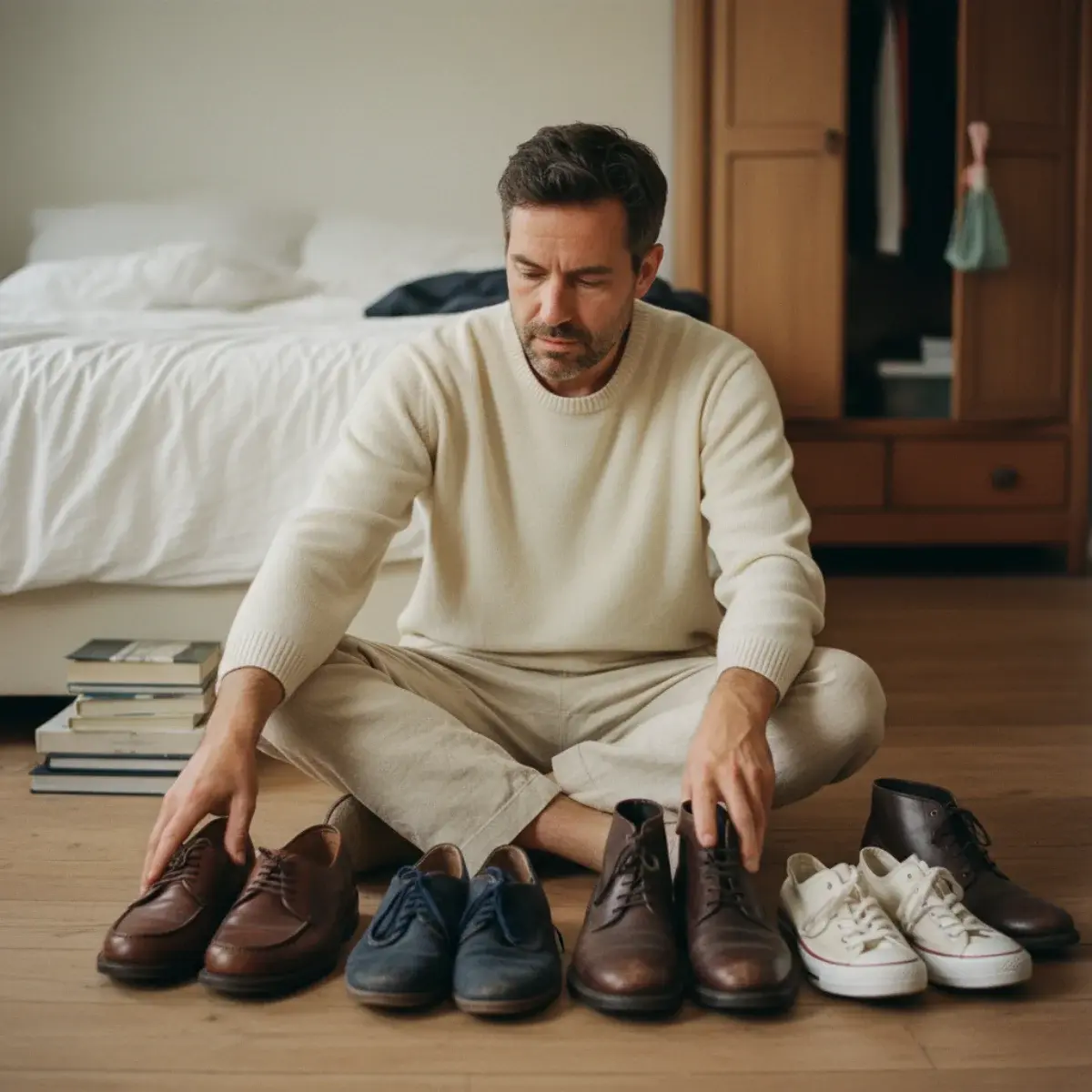
A man's footwear does more work than any other category in his wardrobe. The shoe is the only piece visible from every angle, the only piece that touches the ground, and the piece that most reliably gives away whether the outfit was thought through. A perfectly-cut suit dies above a scuffed pair of square-toed dress shoes. A plain t-shirt and jeans graduates the moment it sits above a clean white sneaker or a tobacco suede boot.
The line this guide holds: buy fewer shoes, buy them well, and resole the welted ones. A pair of Goodyear-welted leather shoes that costs $300 will outlast three pairs of $100 cemented-construction shoes, look better as it ages, and can be sent back to a cobbler for a new sole when the original wears through. Most men own too many cheap shoes and not enough good ones. This guide is about the five that earn their place.
1. The white minimalist leather sneaker
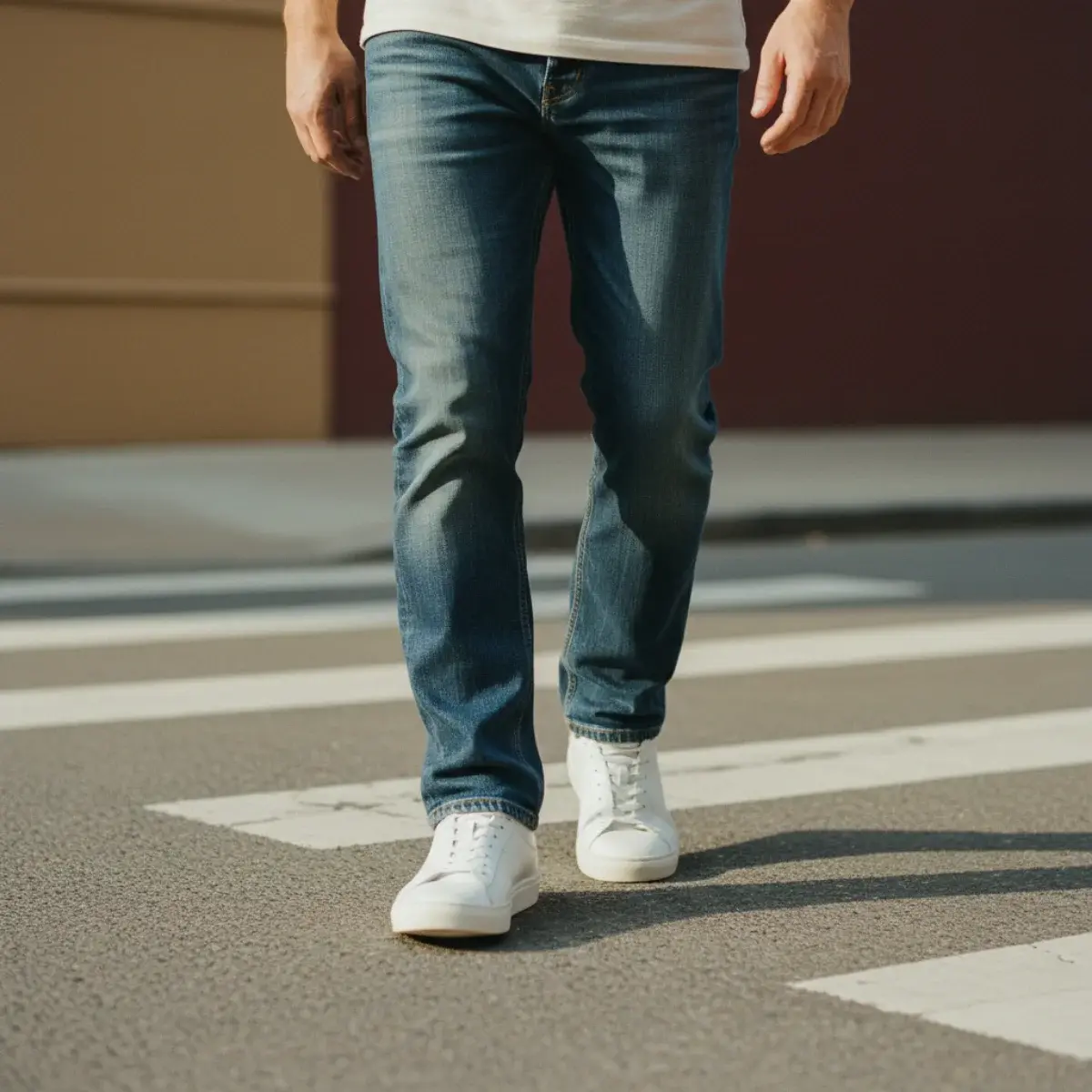
The most versatile shoe in a modern men's wardrobe. A clean, low-profile white leather sneaker with a thin sole, no visible logo, and minimal athletic styling pairs with casual jeans, chinos, an unstructured blazer, even (carefully) a creative-industry suit. It is the shoe that makes the t-shirt-and-jeans look intentional, not lazy.
 1600×1067
What to look for. Full-grain leather upper, a thin (under 3cm) sole, an unbranded or discreetly-branded toe, and a clean white shoelace that you replace the moment it greys. Common archetypes: Common Projects Achilles, Veja Esplar, Oliver Cabell Low 1, Greats Royale. Budget alternatives exist — but be wary of canvas or PU "leather" sneakers in this style; they yellow within a year.
Care. Wipe with a damp cloth weekly, apply a leather cream every two months, and keep a magic eraser for the sole. White sneakers die from grey soles before they die from anything else.
Where it doesn't work. A traditional business suit. A black-tie or formal evening event. A muddy autumn day — switch to the chukka.
2. The brown suede chukka or desert boot
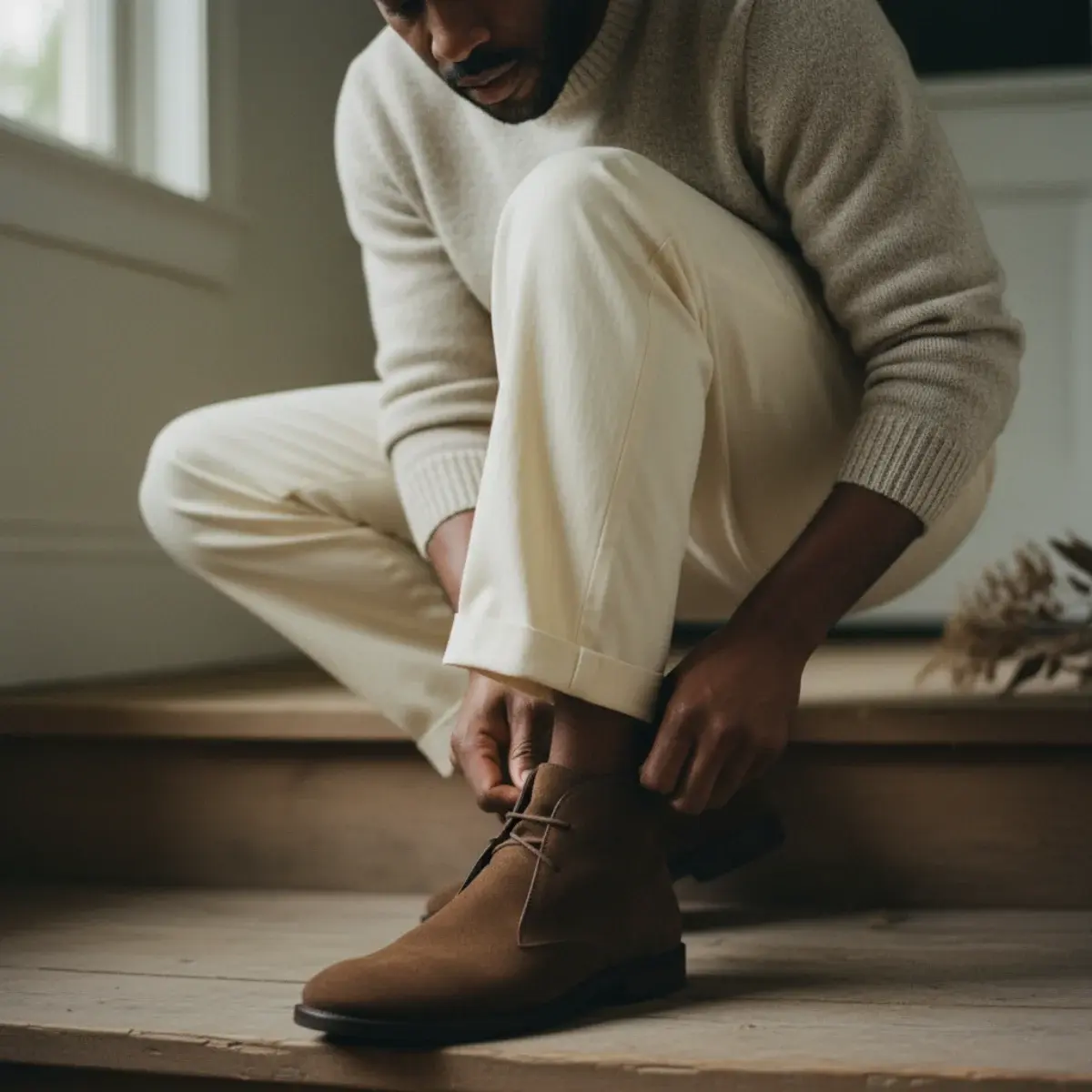
The shoe that bridges casual and smart-casual better than anything else. A brown suede chukka (two or three eyelets, no broguing, no decoration) pairs with jeans for the weekend, chinos for the bar, even an unstructured blazer-and-jean combination for a casual office. In tobacco or a medium brown, it's a warmer alternative to the white sneaker when the weather pivots toward autumn.
 1600×1067
What to look for. Full suede upper (not "suede-textured" leather), a crepe sole (more casual) or a leather sole (smarter), and a clean two- or three-eyelet construction. Clarks Originals Desert Boot is the archetype; Crockett & Jones, Sanders, and Meermin make smarter leather-soled versions.
Care. Spray new suede with a quality protector before the first wear. Brush regularly with a suede brush after each wear. Reapply protector every two months in wet seasons. Avoid heavily salted winter streets. Suede looks fragile but, properly cared for, lasts longer than most men assume.
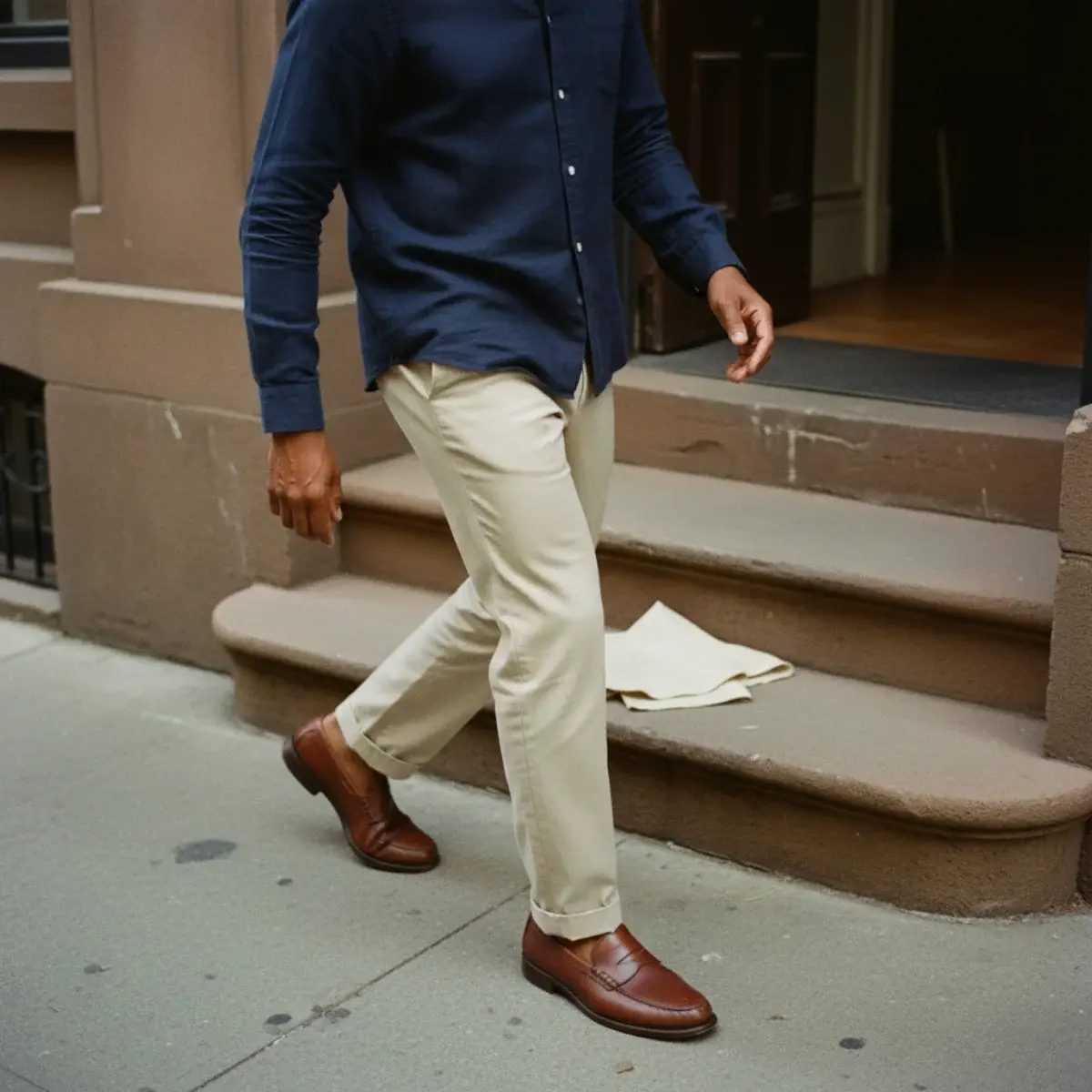
3. The brown leather penny loafer
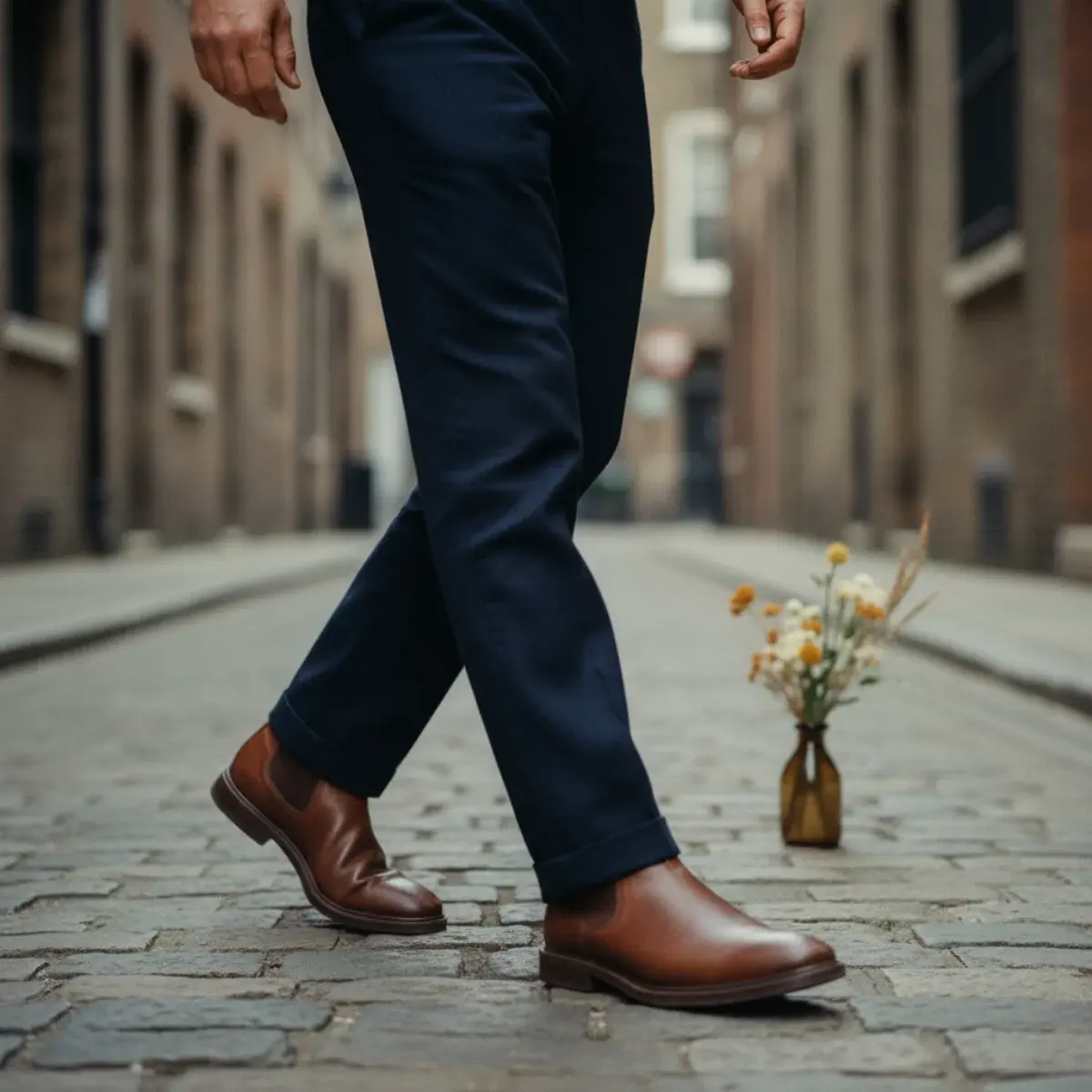
The smart-casual workhorse. A brown leather penny loafer — in a medium-dark brown like dark walnut or oxblood — pairs with chinos, wool trousers, dark jeans, and an unstructured suit. In the right room, it works for a traditional office; in a less formal room, it works for dinner. See our full loafer styling guide for the full breakdown.
 1600×1067
What to look for. Full-grain leather upper, leather sole or a slim Dainite-rubber sole for wet weather, and a moderate (1.5–2.5cm) heel. Avoid chunky-soled "modern" loafers — they read like dress shoes pretending to be sneakers, and pair well with neither. Allen Edmonds Cavanaugh, Carmina, Crockett & Jones Boston, Meermin Linea Maestro.
Sockless or socks? Either, depending on the context. With chinos in summer, no-show socks read intentional. With trousers and a blazer, a proper mid-calf dress sock in a complementary colour reads adult. White ankle socks visible above the loafer reads collegiate — only deliberately.
4. The black or oxblood oxford or derby
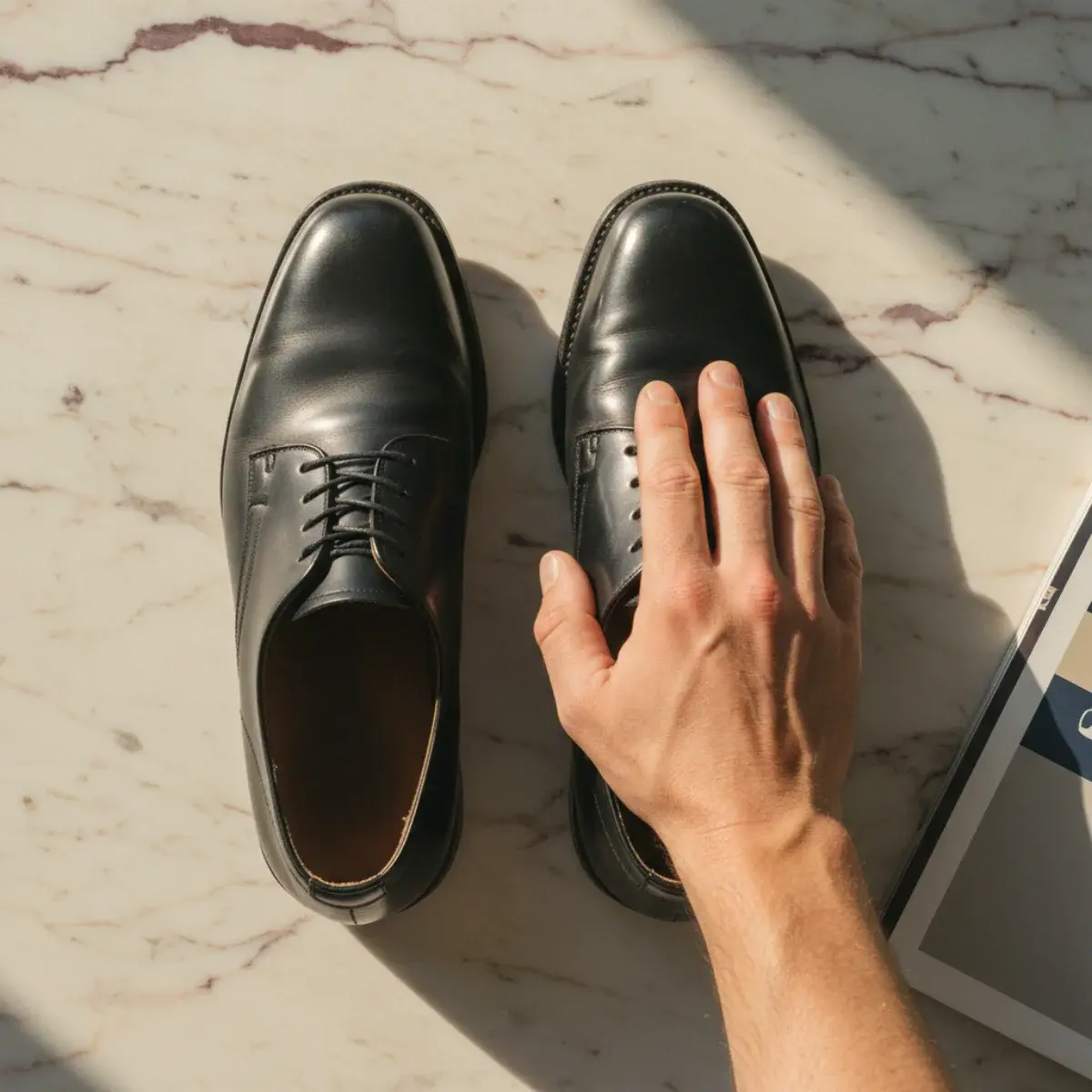
The dress shoe. For most modern men, this is one pair, not five — bought well and worn for the occasions that genuinely require formal footwear: a business interview, a traditional office, a wedding, a funeral, a black-tie-adjacent event.
 1600×1067
The dress shoe is the one pair where construction matters more than fashion. Buy welted, resole when needed, keep them for decades.
Oxford or derby — which? An oxford (closed lacing) is more formal: it's the right shoe for a business suit, a wedding, a strict-dress-code event. A derby (open lacing) is more versatile: it works with a suit but also with grey flannel trousers and a sport coat, and reads slightly less stiff. Most men only need a derby unless their work requires the oxford specifically.
Black or oxblood? Black is essential if your work or social calendar genuinely needs a formal shoe — it's the only correct colour with a black tuxedo or charcoal business suit. Oxblood (dark burgundy) is a more versatile choice if your wardrobe leans toward navy and grey suits and you don't own a true formal black-tie outfit; it pairs beautifully with both and adds depth to a navy suit a black shoe can't.
What to look for. Goodyear-welted or Blake-rapid construction (resolable), full-grain leather upper, a leather sole. Closed-channel sole stitching reads more refined. Allen Edmonds Park Avenue (oxford) or Carmina Simpson last (derby) are workhorses; Crockett & Jones, Edward Green, and Carmina higher-grade lines reward investment if you'll wear them weekly.
5. The dedicated training or running shoe
The gym shoe is the only place where athletic styling, branding, and synthetic materials belong. Buy what's right for the activity you actually do — a proper running shoe if you run, a low-drop cross-trainer if you lift, a court shoe if you play basketball or tennis — and don't wear it for anything else. The fastest way to ruin the "considered casual" of a t-shirt-and-jeans look is to put a cushioned running shoe under it. The men's gym outfits guide walks the rest of the workout wardrobe.
 1600×1067
The exception: a clean, low-profile court sneaker (a Stan Smith, a Reebok Club C, a Vans Authentic) crosses into casual outfits as a deliberate sporty choice, paired with shorts or a relaxed jean.
Key takeaways
- 1Five pairs cover virtually every situation a modern man dresses for: white leather sneaker, brown suede chukka, brown loafer, black or oxblood dress shoe, training shoe.
- 2Buy brown leather before black — brown pairs with vastly more of a modern men's wardrobe.
- 3Welted construction (Goodyear or Blake-rapid) is the single biggest quality marker. Welted shoes can be resoled and last decades; cemented shoes can't.
- 4Open lacing (derby) is more versatile than closed lacing (oxford). Most men only need the derby.
- 5Loafers want either a no-show sock or a proper dress sock. Visible white ankle socks are a deliberate collegiate choice, not a default.
- 6Suede looks fragile but, sprayed and brushed, outlasts cheap leather. Protect on day one.
The order to buy in
If you're starting from scratch and building one piece at a time, the order is:
- White leather sneaker — used most days, makes the largest visual difference fastest.
- Brown suede chukka or desert boot — the second most-worn shoe in most modern wardrobes.
- Brown leather penny loafer — once the first two are in rotation, the loafer opens up smart casual.
- Black or oxblood dress shoe — only when work or social calendar actually requires it.
- Training shoe — for actual training, kept separate.
Some men never need #4. A man who works in a creative-industry office, who attends weddings rarely, and who has no formal social calendar can build a complete shoe wardrobe from pairs #1–#3 plus a training shoe, and never own a true dress shoe. That's a legitimate choice — better than owning a cheap formal shoe used twice a year.
Where to spend, where to save
| Pair | Spend bracket | Why |
|---|---|---|
| White leather sneaker | $150–$300 | Above $300, diminishing returns. Below $150, the leather yellows fast. |
| Suede chukka | $130–$280 | Mid-range welted construction outperforms cheap brands here. |
| Penny loafer | $250–$500 | This is where welted construction starts paying off — a $400 pair lasts a decade. |
| Dress oxford/derby | $300–$700 | Wear-frequency varies; spend in proportion to how often you'll wear it. |
| Training shoe | $80–$160 | Buy for performance, replace every 500–800 miles or every 12–18 months. |
The principle: spend more on welted leather construction, less on synthetic athletic shoes that will be replaced regardless of price. A $600 leather shoe resoled four times costs roughly the same per year of life as a $150 shoe replaced annually — and looks dramatically better.
Comparison: matching shoes to outfits
| Outfit | Best shoe | Avoid |
|---|---|---|
| T-shirt + jeans | White leather sneaker | Loafer (reads tryhard) |
| Henley + selvedge jeans | Brown suede chukka | White sneaker (clashes with the rugged top) |
| Polo + chino | Brown leather loafer | Athletic sneaker |
| Unstructured blazer + jeans | White sneaker or loafer | Chunky-sole anything |
| Business suit | Oxford or derby in black/oxblood | White sneaker (with rare exceptions) |
| Linen shirt + trousers (summer) | Leather sandal or loafer (sockless) | Boot |
| Gym | Training/running shoe | Anything else |
Caring for them so they last
The shoes that last are the shoes that are cared for. The non-negotiables:
Rotation. Never wear the same pair two days in a row. Leather needs 24 hours to dry from the day's moisture; back-to-back wear cracks the leather faster than anything else. Owning three pairs you rotate beats owning five pairs you don't.
Trees. Wooden shoe trees (cedar, ideally) absorb moisture, hold the shape, and prevent the leather from creasing into permanent grooves. Insert immediately on removing the shoe. One pair of trees per pair of leather shoes is non-optional for anything you intend to keep more than two years.
Cream. A leather cream — not just a polish — every six to eight weeks. Cream rehydrates the leather; polish only adds surface shine. Choose a cream that matches the shoe's colour, or use a neutral cream and follow with a coloured wax polish.
Suede brush + protector spray. Suede gets brushed after every wear and re-sprayed with protector every couple of months. Salt stains can be removed with a damp cloth and a soft brush; tough stains need a dedicated suede eraser.
Cobbler. Find one. A good cobbler can resole a welted shoe, recondition the upper, replace a heel, and tighten loose stitching. Most leather-shoe deaths are preventable by a $40 visit a man didn't make.
The shoes that don't earn a slot
Worth saying out loud, because the wardrobe is built as much by what's not in it: square-toed dress shoes (a 2010s mistake; the toe should be almond, round, or chiseled — never square); chunky-soled "fashion" loafers (commit to either dress or casual, not the costume hybrid); driving moccasins worn outside the car (they're designed for inside the car); orthopaedic-looking "comfort" shoes (a properly-fitted welted shoe is comfortable after break-in); and any shoe with visible large branding or a slogan.
See all men's outfit guides → · How to style loafers → · The footwear styling guide →
The five pairs, summarised
If you only remember one paragraph from this guide: a modern man dresses for almost every situation he encounters with a clean white leather sneaker, a brown suede chukka, a brown leather loafer, a black or oxblood derby, and a dedicated training shoe. The white sneaker handles casual. The chukka bridges casual to smart casual. The loafer handles smart casual and most offices. The derby handles the rest. The training shoe stays at the gym. Add a leather sandal for summer if you live somewhere warm, and the wardrobe is complete. Five pairs, properly chosen and cared for, will out-perform a closet of fifteen — and that's the whole argument of this guide.
Frequently asked
- How many pairs of shoes does a man actually need?
- Five covers virtually every situation: a white minimalist leather sneaker (casual), a brown suede chukka or desert boot (transition), a brown leather penny loafer (smart casual to office), a black or oxblood oxford or derby (formal and office), and a pair of dedicated running or training shoes (gym). Add a leather sandal if you live somewhere warm. That's the wardrobe.
- Brown or black shoes — which do I buy first?
- Brown. A medium-to-dark brown shoe pairs with charcoal, navy, olive, tan, oatmeal, and almost every casual palette a man wears. Black is more limited — it really only pairs with grey, navy, and black, and reads more formal. Build brown first; add black when the wardrobe requires it.
- Are dress sneakers OK to wear with a suit?
- Yes, in the right context — a clean white or off-white minimalist leather sneaker (no logo, no chunky sole, no athletic styling) works under an unstructured suit at a less formal event, a wedding without a strict dress code, or a creative-industry office. For a traditional business suit, a true formal interview, or a black-tie-adjacent event, wear a proper leather shoe.
- What's the difference between a loafer, a derby, and an oxford?
- A loafer is a slip-on with no laces — most casual of the three. A derby has open lacing (the eyelet flaps sit on top of the vamp) — versatile, work-appropriate. An oxford has closed lacing (the eyelet flaps are stitched under the vamp) — the most formal of the three, the right shoe for a business suit. The same shoe in different lacing systems gives you very different dress codes.
- How do I know if a shoe fits properly?
- Your heel should sit firmly in the heel cup with no slip when you walk; the ball of your foot should sit at the widest part of the shoe; and there should be roughly a thumb's width between your longest toe and the end of the shoe. Length and width matter equally — a too-narrow shoe in your right length is more painful than a slightly long shoe in the right width.
- What's the best brand for men's leather shoes?
- Quality scales smoothly with price up to about $400, then more slowly. Below $150 most leather shoes are corrected-grain or bonded leather and won't age well; $150–$300 buys solid Goodyear-welted shoes from Meermin, Loake, Allen Edmonds, Beckett Simonon; $400+ gets you full-grain leather and longer-lifespan construction. Buy welted construction whenever budget allows — it can be resoled, doubling or tripling the shoe's life.
- Can I wear suede shoes in winter?
- Yes, if you protect them. Spray new suede with a high-quality waterproofer before the first wear, re-spray every couple of months in wet seasons, and avoid wearing suede on heavily salted streets. A suede chukka or desert boot is one of the best transitional shoes a man can own, and dies fast only if you treat it like a leather shoe.
Written by Theo Ashworth, looksyra editorial. Last updated May 2026.